0042. Trapping Rain Water
Given n non-negative integers representing an elevation map where the width of each bar is 1, compute how much water it can trap after raining.
Example 1:
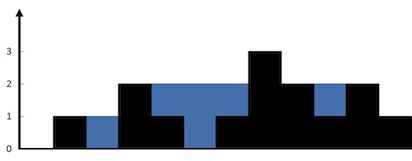
Input: height = [0,1,0,2,1,0,1,3,2,1,2,1]
Output: 6
Explanation: The above elevation map (black section) is represented by array [0,1,0,2,1,0,1,3,2,1,2,1]. In this case, 6 units of rain water (blue section) are being trapped.
Example 2:
Input: height = [4,2,0,3,2,5]
Output: 9
Constraints:
n == height.length0 <= n <= 3 * 1040 <= height[i] <= 105
Analysis
To trap water, there should be a U shape, which means we need to have three points: left (high), mid (low), and right (high). To find such points, we need to maintain a monotonic stack, which only accepts points that are less than the current one, so that when new points come in, we can find the three qualifying points.
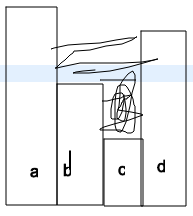
Taking this example, we can see that for d, it will start to trap water for b, c, d first: area = (min(b, d) - c) * (distance between b and d). We can do this calculation for a, b, d as well: area = (min(a, d) - b) * (distance between a and d). By observation, we can see that we are just calculating the area of a rectangle lying on its side, with height as the height difference and width as the distance between two bars.
- Time: O(n) we push each element exactly once, and we pop each element exactly once.
- Space: O(n) the stack can contain all the elements.
Code
class Solution {
public:
    int trap(vector<int>& height) {
        int n = height.size(), res = 0;
        stack<int> st;
        for (int i = 0; i < n; ++i) {
            if (st.empty()) st.push(i);
            else {
                while (!st.empty() && height[st.top()] < height[i]) {
                    int t = st.top();
                    st.pop();
                    if (st.empty()) break;
                    res += (i - st.top() - 1) * (min(height[i], height[st.top()]) - height[t]);
                }
                st.push(i);
            }
        }
        return res;
    }
};