0542. 01 Matrix
Given an m x n binary matrix mat, return the distance of the nearest 0 for each cell.
The distance between two adjacent cells is 1.
Example 1:
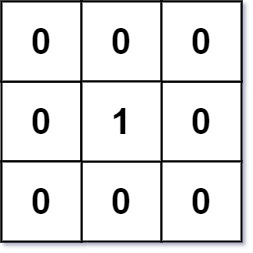
Input: mat = [[0,0,0],[0,1,0],[0,0,0]]
Output: [[0,0,0],[0,1,0],[0,0,0]]
Example 2:
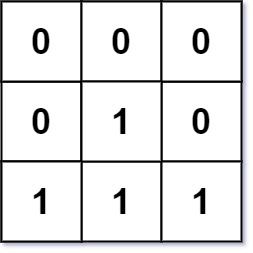
Input: mat = [[0,0,0],[0,1,0],[1,1,1]]
Output: [[0,0,0],[0,1,0],[1,2,1]]
Constraints:
m == mat.lengthn == mat[i].length1 <= m, n <= 1041 <= m * n <= 104mat[i][j]is either0or1.- There is at least one
0inmat.
Analysis
Using BFS to find the shortest path for each point
Compared to single-source BFS, we can regard each "0" as a source and run the search from each point. BFS will guarantee the shortest path, so we can return the search results immediately after each search.
- Scan through all the "0"s and insert their coordinates into the search queue, and initialize a
distmatrix with0at each of those coordinates and-1(unvisited) everywhere else. - Run a standard multi-source BFS: pop a coordinate from the queue, and for each of its 4 neighbors that hasn't been visited yet (
dist == -1), set its distance to the current cell's distance plus one and push it into the queue. -
Keep expanding level by level until the queue is empty. Since every "0" starts the search at distance 0 simultaneously, the first time we reach a cell is guaranteed to be via the shortest path, so
distends up holding the answer for every cell. -
Time: O(mn) since every cell is pushed onto and popped from the queue at most once.
- Space: O(mn) for the
distmatrix and the queue.
Code
class Solution {
public:
    vector<vector<int>> updateMatrix(vector<vector<int>>& mat) {
        int m = mat.size(), n = mat[0].size();
        vector<vector<int>> dist(m, vector<int>(n, -1));
        queue<pair<int, int>> q;
        for (int i = 0; i < m; ++i)
            for (int j = 0; j < n; ++j)
                if (mat[i][j] == 0) {
                    dist[i][j] = 0;
                    q.push({i, j});
                }
        int dir[4][2] = {{0, 1}, {0, -1}, {1, 0}, {-1, 0}};
        while (!q.empty()) {
            int x, y;
            tie(x, y) = q.front();
            q.pop();
            for (auto& d : dir) {
                int dx = x + d[0], dy = y + d[1];
                if (dx < 0 || dx >= m || dy < 0 || dy >= n || dist[dx][dy] != -1)
                    continue;
                dist[dx][dy] = dist[x][y] + 1;
                q.push({dx, dy});
            }
        }
        return dist;
    }
};