0114. Flatten binary tree to linked list
Given the root of a binary tree, flatten the tree into a "linked list":
- The "linked list" should use the same
TreeNodeclass where therightchild pointer points to the next node in the list and theleftchild pointer is alwaysnull. - The "linked list" should be in the same order as a pre-order traversal of the binary tree.
Example 1:
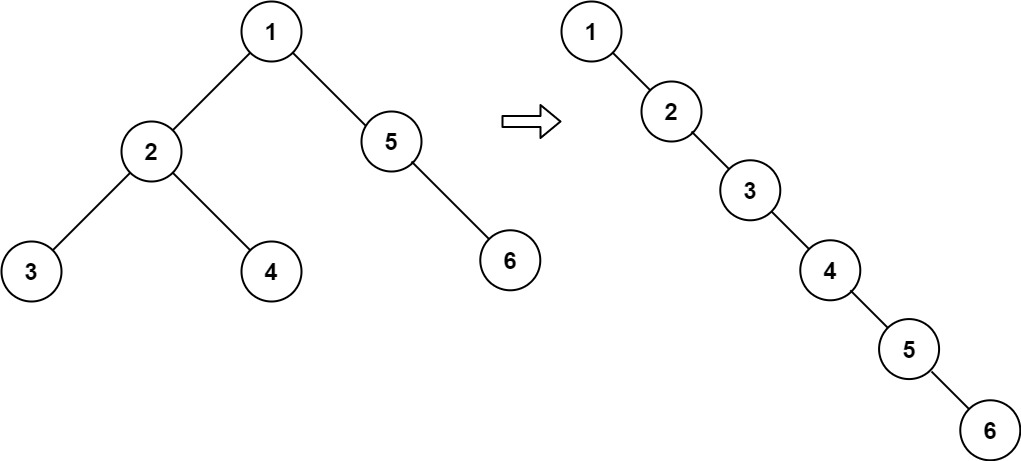
Input: root = [1,2,5,3,4,null,6]
Output: [1,null,2,null,3,null,4,null,5,null,6]
Example 2:
Input: root = []
Output: []
Example 3:
Input: root = [0]
Output: [0]
Constraints:
- The number of nodes in the tree is in the range
[0, 2000]. -100 <= Node.val <= 100
Follow up: Can you flatten the tree in-place (with O(1) extra space)?
Analysis
Method 1: flatten left and right tree, then append the left to the end of right.
Time Complexity: if the tree is fully balanced (left height - right height abs value <= 1), then the tree will have at max log(N) levels; for each node in the recursion tree, it will require log(N) runs for the while loop, so the time complexity is O(log(N) \times N)
Method 2: traverse right then left, then directly append
我们知道题目给定的遍历顺序其实就是先序遍历的顺序,所以我们能不能利用先序遍历的代码,每遍历一个节点,就将上一个节点的右指针更新为当前节点。
先序遍历的顺序是 1 2 3 4 5 6。
遍历到 2,把 1 的右指针指向 2。1 -> 2 3 4 5 6。
遍历到 3,把 2 的右指针指向 3。1 -> 2 -> 3 4 5 6。
... ...
一直进行下去似乎就解决了这个问题。但现实是残酷的,原因就是我们把 1 的右指针指向 2,那么 1 的原本的右孩子就丢失了,也就是 5 就找不到了。
解决方法的话,我们可以逆过来进行。
我们依次遍历 6 5 4 3 2 1,然后每遍历一个节点就将当前节点的右指针更新为上一个节点。
遍历到 5,把 5 的右指针指向 6。6 <- 5 4 3 2 1。
遍历到 4,把 4 的右指针指向 5。6 <- 5 <- 4 3 2 1。
... ...
作者:windliang 链接:https://leetcode-cn.com/problems/flatten-binary-tree-to-linked-list/solution/xiang-xi-tong-su-de-si-lu-fen-xi-duo-jie-fa-by--26/ 来源:力扣(LeetCode) 著作权归作者所有。商业转载请联系作者获得授权,非商业转载请注明出处。
Code 1
/**
 * Definition for a binary tree node.
 * public class TreeNode {
 *     int val;
 *     TreeNode left;
 *     TreeNode right;
 *     TreeNode() {}
 *     TreeNode(int val) { this.val = val; }
 *     TreeNode(int val, TreeNode left, TreeNode right) {
 *         this.val = val;
 *         this.left = left;
 *         this.right = right;
 *     }
 * }
 */
class Solution {
    public void flatten(TreeNode root) {
        if (root == null)
            return;
        flatten(root.left);
        flatten(root.right);
        TreeNode tmp = root.right;
        root.right = root.left;
        root.left = null;
        while (root.right != null) root = root.right;
        root.right = tmp;
    }
}
Code 2
/**
 * Definition for a binary tree node.
 * public class TreeNode {
 *     int val;
 *     TreeNode left;
 *     TreeNode right;
 *     TreeNode() {}
 *     TreeNode(int val) { this.val = val; }
 *     TreeNode(int val, TreeNode left, TreeNode right) {
 *         this.val = val;
 *         this.left = left;
 *         this.right = right;
 *     }
 * }
 */
class Solution {
    private TreeNode pre = null;

    public void flatten(TreeNode root) {
        if (root == null)
            return;
        flatten(root.right);
        flatten(root.left);
        root.right = pre;
        root.left = null;
        pre = root;
    }
}