0116. Populating Next Right Pointers in Each Node
You are given a perfect binary tree where all leaves are on the same level, and every parent has two children. The binary tree has the following definition:
struct Node {
  int val;
  Node *left;
  Node *right;
  Node *next;
}
Populate each next pointer to point to its next right node. If there is no next right node, the next pointer should be set to NULL.
Initially, all next pointers are set to NULL.
Example 1:
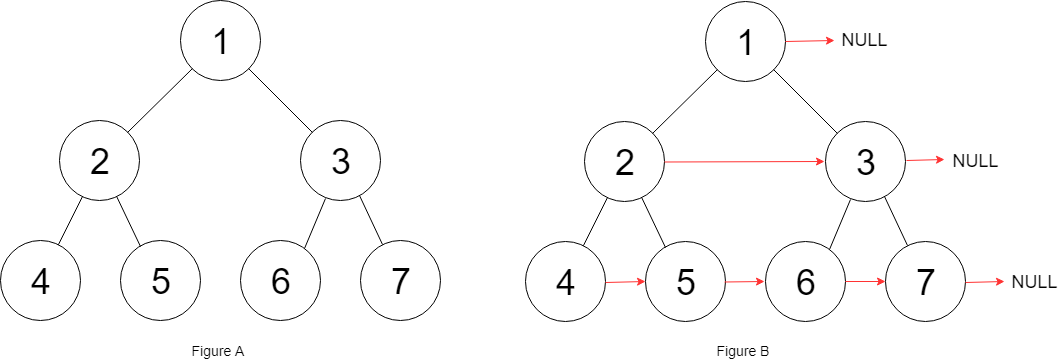
Input: root = [1,2,3,4,5,6,7]
Output: [1,#,2,3,#,4,5,6,7,#]
Explanation: Given the above perfect binary tree (Figure A), your function should populate each next pointer to point to its next right node, just like in Figure B. The serialized output is in level order as connected by the next pointers, with '#' signifying the end of each level.
Example 2:
Input: root = []
Output: []
Constraints:
- The number of nodes in the tree is in the range
[0, 212 - 1]. -1000 <= Node.val <= 1000
Follow-up:
- You may only use constant extra space.
- The recursive approach is fine. You may assume implicit stack space does not count as extra space for this problem.
Analysis
Using recursion/DFS traversal
We could use DFS to solve this question by connecting the sibling nodes in a recursive fashion. Be mindful of the case when we need to connect right child with the left child from a different parent root. We need to use node -> right -> next to check if such a case exists.
- Time: O(n)
- Space: O(n) in the linked list case
Using level/BFS traversal
More straightforward, yet needs extra caution. For each iteration, we should start from the left-most node of the tree, which means our while loop should be going deeper by moving to the root -> left node. Using this method, we can save some space because we don't need to hold the call stack space any more.
- Time: O(n)
- Space: O(1)
Code
Recursion
/*
// Definition for a Node.
class Node {
public:
    int val;
    Node* left;
    Node* right;
    Node* next;

    Node() : val(0), left(NULL), right(NULL), next(NULL) {}

    Node(int _val) : val(_val), left(NULL), right(NULL), next(NULL) {}

    Node(int _val, Node* _left, Node* _right, Node* _next)
        : val(_val), left(_left), right(_right), next(_next) {}
};
*/

class Solution {
public:
    Node* connect(Node* root) {
        if (!root) return nullptr;
        if (root -> left) { // we only need to traverse when the left node exists
            root -> left -> next = root -> right;
            if (root -> next) {
                root -> right -> next = root -> next -> left;
            }

            connect(root -> left);
            connect(root -> right);
        }
        return root;
    }
};
Level
/*
// Definition for a Node.
class Node {
public:
    int val;
    Node* left;
    Node* right;
    Node* next;

    Node() {}

    Node(int _val, Node* _left, Node* _right, Node* _next) {
        val = _val;
        left = _left;
        right = _right;
        next = _next;
    }
};
*/
class Solution {
public:
    Node* connect(Node* root) {
        Node* ret = root;
        while (root && root -> left) {
            Node* curr = root;
            while (curr) {
                curr -> left -> next = curr -> right;
                curr -> right -> next = curr -> next ? curr -> next -> left : NULL;
                curr = curr -> next;
            }
            root = root -> left;
        }
        return ret;
    }
};