0222. Count Complete Tree Nodes
Given the root of a complete binary tree, return the number of the nodes in the tree.
According to Wikipedia, every level, except possibly the last, is completely filled in a complete binary tree, and all nodes in the last level are as far left as possible. It can have between 1 and 2h nodes inclusive at the last level h.
Example 1:
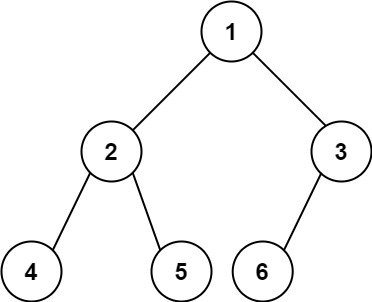
Input: root = [1,2,3,4,5,6]
Output: 6
Example 2:
Input: root = []
Output: 0
Example 3:
Input: root = [1]
Output: 1
Constraints:
- The number of nodes in the tree is in the range
[0, 5 * 104]. 0 <= Node.val <= 5 * 104- The tree is guaranteed to be complete.
Follow up: Traversing the tree to count the number of nodes in the tree is an easy solution but with O(n) complexity. Could you find a faster algorithm?
Analysis
A complete binary tree has the special property: at the last level of the binary tree, the nodes will be populated from left to right. There could be empty/null nodes at any point in the last level, but from the first empty/null node, all the rest to the right have to be empty/null as well.
If we are given a perfect binary tree, we can use 2^{height} - 1 to calculate the total number of nodes in the tree. The problem now breaks down to finding the position starting at which the rest of the leaf nodes become empty/null. We can use binary search to find the pivot node.
- start from left and right, and traverse \log(n) levels to see the heights of left and right.
- if left and right heights are the same, it means we are already in a perfect binary tree -> we can use the formula to calculate the number of nodes in the current subtree.
-
if left = right + 1, then the pivot should be somewhere between left and right, so we should recursively call both.
-
Time: \log^2 (n)
- Space: \log(n) -> it takes \log(n) times to find the pivot, thus it will call the recursion \log(n) times.
Code
/**
 * Definition for a binary tree node.
 * struct TreeNode {
 *     int val;
 *     TreeNode *left;
 *     TreeNode *right;
 *     TreeNode() : val(0), left(nullptr), right(nullptr) {}
 *     TreeNode(int x) : val(x), left(nullptr), right(nullptr) {}
 *     TreeNode(int x, TreeNode *left, TreeNode *right) : val(x), left(left), right(right) {}
 * };
 */
class Solution {
public:
    int countNodes(TreeNode* root) {
        if (!root) return 0;
        int l = 0, r = 0;
        TreeNode *a = root, *b = root;
        while (a) {
            a = a -> left;
            l++;
        }
        while (b) {
            b = b -> right;
            r++;
        }
        if (l == r) return pow(2, l) - 1;
        return countNodes(root -> left) + countNodes(root -> right) + 1;
    }
};