1240. Tiling a Rectangle with the Fewest Squares
Given a rectangle of size n x m, find the minimum number of integer-sided squares that tile the rectangle.
Example 1:
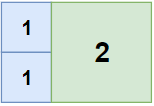
Input: n = 2, m = 3
Output: 3
Explanation: 3 squares are necessary to cover the rectangle.
2 (squares of 1x1)
1 (square of 2x2)
Example 2:
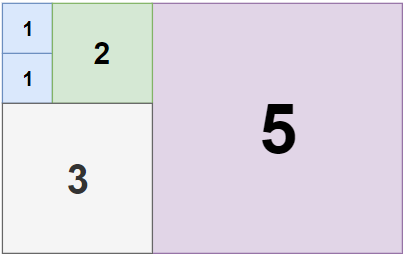
Input: n = 5, m = 8
Output: 5
Example 3:
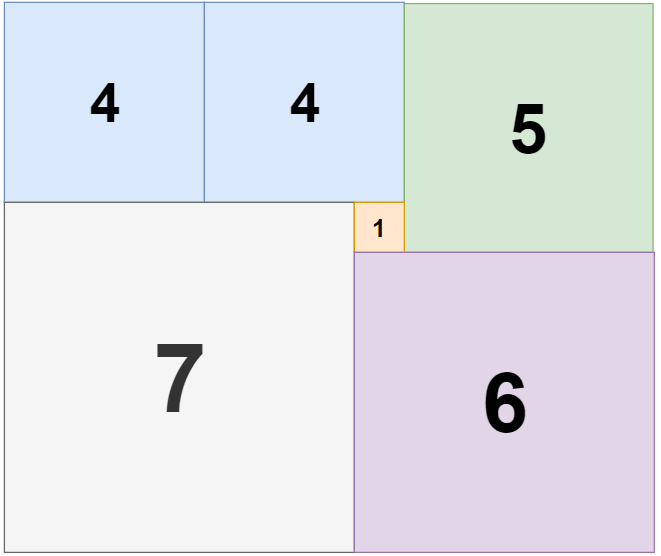
Input: n = 11, m = 13
Output: 6
Constraints:
1 <= n <= 131 <= m <= 13
Analysis
If you think about using a greedy algorithm to solve this problem, you will probably fail. If you try to fill the rectangular space from largest to smallest, it is not guaranteed to be the most optimal solution. Check 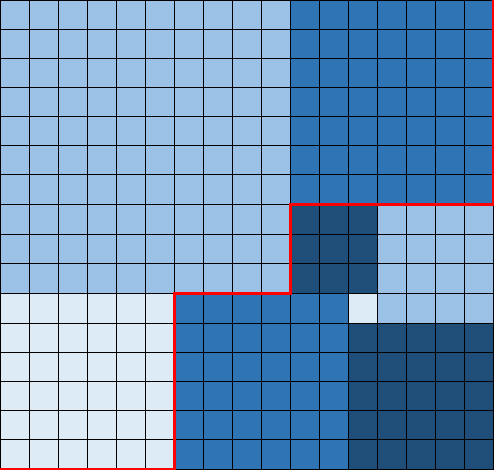
On the middle right, it has splayed the right down region with the upper right region, which breaks the greedy algorithm.
So instead, we go back to using the rudimentary DFS search solution. Imagine you can fill the rectangle as a skyline problem (from left to right, bottom to top). Your task is to fill all parts of the rectangle. We use a height[i] array to represent the skyline. If our skyline has the same height as the given height m, then we have reached our base case. We update the answer with the current minimal.
if (min_height == m) {
  res = min(cnt, res);
  return;
}
To place the next block, we try to eagerly find the next square from the current concave shape skyline. We need to first determine the largest block to be filled with, and then update the new height with the current skyline.
int left = 0, min_height = m;
for (int i = 0; i < n; ++i) {
  if (heights[i] < min_height)
    min_height = heights[left = i];
}

if (min_height == m) {
  res = min(cnt, res);
  return;
}
int right = left;
// giving space for square with width and height equal to min_height
while (right < n && heights[left] == heights[right] &&
       // check width to fit in m
       right - left + min_height < m)
  right++;
// update the new height
for (int i = left; i < right; ++i)
  heights[i] += right - left;
Now we have filled the next largest square piece in the block, and we need to recursively find the next one from the current shape. However, at this point we cannot just keep doing it greedily, since we have proven it won't work for some cases. What we do is try all the squares starting from the current largest square we have occupied, and decrease the height[i] one by one.
 for (int size = right - left; size >= 1; --size) {
   // try the largest square first
   dfs(n, m, heights, cnt + 1, res);
   // try other squares by decreasing the size of it, or "recover" the original block
   for (int i = left; i < left + size - 1; ++i)
     heights[i] --;
   heights[left + size - 1] -= size;
 }
- Time: O(n^4), in each iteration we have n^2 complexity, and we can run the program from any point of the 2D matrix, so in total it is n^2 \times n^2
- Space: O(n^2) both the stack space and the
height[i]array.
Code
class Solution {
    public:
    void dfs(int n, int m, vector<int>& heights, int cnt, int& res) {
        if (cnt >= res) return;
        // left: min_height's index, if there are multiple min_heights, it uses the leftmost min_height's index
        int left = 0, min_height = m;
        for (int i = 0; i < n; ++i) {
            if (heights[i] < min_height)
                min_height = heights[left = i];
        }

        if (min_height == m) {
            res = min(cnt, res);
            return;
        }
        int right = left;
        // giving space for square with width and height equal to min_height
        while (right < n && heights[left] == heights[right] && right - left + min_height < m)
            right++;
        for (int i = left; i < right; ++i)
            heights[i] += right - left;
        for (int size = right - left; size >= 1; --size) {
            dfs(n, m, heights, cnt + 1, res);
            for (int i = left; i < left + size - 1; ++i)
                heights[i] --;
            heights[left + size - 1] -= size;
        }

    }
    int tilingRectangle(int n, int m) {
        if (n > m) return tilingRectangle(m, n);
        vector<int> heights(n);
        int res = INT_MAX;
        dfs(n, m, heights, 0, res);
        return res;
    }
};