1047. Remove All Adjacent Duplicates in String
Given a string S of lowercase letters, a duplicate removal consists of choosing two adjacent and equal letters, and removing them.
We repeatedly make duplicate removals on S until we no longer can.
Return the final string after all such duplicate removals have been made. It is guaranteed the answer is unique.
Example 1:
Input: "abbaca"
Output: "ca"
Explanation:
For example, in "abbaca" we could remove "bb" since the letters are adjacent and equal, and this is the only possible move.  The result of this move is that the string is "aaca", of which only "aa" is possible, so the final string is "ca".
Note:
1 <= S.length <= 20000Sconsists only of English lowercase letters.
Analysis: using stack
Because it requires us to continuously merge and delete chars that are the same, we should think about using a stack to solve this problem.
Code 1
Using a stack to maintain the resulting string, if there is a duplicate with the ongoing char, we just keep popping the stack (the top) in O(1) and put the ongoing char back on the stack.
class Solution {
public:
    string removeDuplicates(string s) {
        int n = s.length();
        string res;
        for (int i = 0; i < n; ++i) {
            if (!res.empty() && res.back() == s[i])
                res.pop_back();
            else
                res += s[i];
        }
        return res;
    }
};
Analysis: two pointers
The first solution requires allocating a new string to be returned (as a stack), which will create space overhead for the new string (if the string is all distinct, then the returned string will have the same size as the input string). To solve this, we can use two pointers to mimic the stack operations, and then use substr from C++ to split the string (although substr also makes a copy, if it's a linked list, we can just delete the remaining part in place).
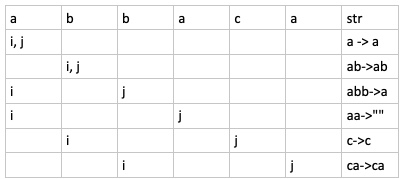
- i: everything from 0:i is distinct (our returned string).
- j: probing pointer that will examine whether our new string needs to be "shrunk" or not.
- assign s[i] = s[j]
- examine if s[i] == s[i - 1]; if so, that means the jth char is invalid, and we just need to step back by 2 (the previous one is also going to be deleted).
e.g. s = "abbaca"
Code 2
class Solution {
public:
    string removeDuplicates(string s) {
        int i = 0, n = s.length();
        for (int j = 0; j < n; ++j, ++i) {
            s[i] = s[j];
            if (i > 0 && s[i - 1] == s[i])
                i -= 2; // not only removes itself but also the remaining one from the previous iteration
        }
        return s.substr(0, i);
    }
};